

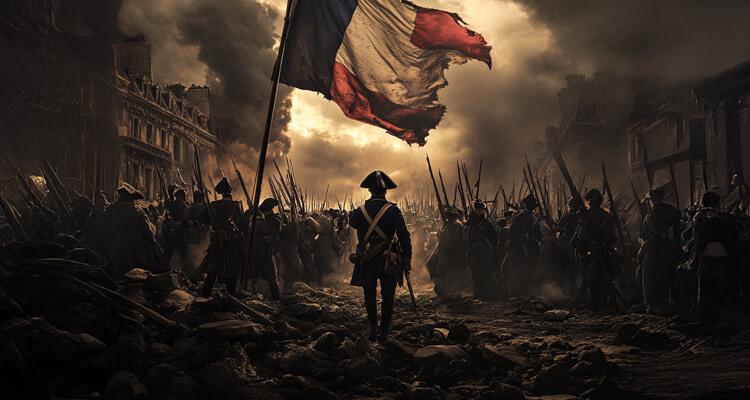
The French Revolution is often remembered for its rallying cry of Liberty, Equality, Fraternity. Those ideals reshaped France and influenced democracies around the world. Yet the Revolution was also marked by famine, political violence, civil war, and mass executions that claimed tens of thousands of lives.
For many people, the guillotine has become the defining image of the Revolution. In reality, it represents only one chapter in a much larger story. The French Revolution transformed society, but it also revealed how quickly noble ideals can give way to fear, revenge, and authoritarian rule.
Why the Revolution Began
By the late eighteenth century, France was facing a crisis on several fronts.
The country still operated under the Ancien Régime, a system that divided society into three estates: the clergy, the nobility, and the common people. The Third Estate made up the overwhelming majority of the population and carried most of the tax burden, while the privileged classes enjoyed significant exemptions.
Economic conditions made matters worse. Years of expensive wars, including France’s support of the American Revolution, had left the government deeply in debt. Poor harvests caused food shortages, bread prices soared, and many families struggled simply to survive.
At the same time, Enlightenment thinkers such as Voltaire, Rousseau, and Montesquieu challenged long-held beliefs about monarchy and political authority. Their ideas about individual rights and representative government inspired growing demands for reform.
When King Louis XVI called the Estates-General in 1789 to address the financial crisis, he unintentionally opened the door to a revolution that would transform France forever.
The Fall of the Monarchy
One of the Revolution’s defining moments came on July 14, 1789, when revolutionaries stormed the Bastille prison.
Although the fortress held relatively few prisoners, it represented royal authority, and its capture quickly became a powerful symbol of resistance. Across France, peasants attacked feudal estates, destroyed records of noble privileges, and challenged the old social order.
The monarchy steadily lost control.
Later that year, thousands of Parisian women marched to Versailles, demanding affordable bread and forcing the royal family to relocate to Paris. Their failed attempt to escape the country during the Flight to Varennes in 1791 further damaged public trust.
By 1792, France had abolished the monarchy and declared itself a republic.
King Louis XVI was tried for treason and executed by guillotine in January 1793. Queen Marie Antoinette followed several months later.
When Revolution Became Terror
The execution of the king did not bring stability.
Instead, France entered one of the darkest periods of the Revolution, now known as the Reign of Terror.
Led largely by Maximilien Robespierre and the Jacobins, the revolutionary government argued that extraordinary measures were necessary to protect the republic from internal enemies and foreign invasion. Revolutionary tribunals prosecuted suspected opponents, often with limited evidence.
The guillotine became a symbol of revolutionary justice.
Thousands of people lost their lives during the Terror, including nobles, clergy, political rivals, and ordinary citizens accused of supporting the old regime. Revolutionary leaders who had once stood together also turned against one another. Georges Danton and Camille Desmoulins, both important figures in the Revolution, were eventually executed alongside many former allies.
As suspicion spread, fear became one of the government’s most effective tools.
Ironically, Robespierre himself fell victim to the system he helped create. He was arrested and executed in July 1794, bringing the Reign of Terror to an end.
The War in the Vendée
While Paris experienced political upheaval, western France faced a devastating civil war.
The Vendée region strongly opposed many revolutionary policies, particularly mandatory military service and restrictions placed on the Catholic Church. What began as a local uprising developed into a prolonged and violent conflict.
Government forces responded with overwhelming force.
Entire villages were destroyed, thousands of civilians were killed, and mass drownings carried out in Nantes became one of the Revolution’s most notorious atrocities.
Historians continue to debate how these events should be classified. Some argue they meet the definition of genocide, while others describe them as an exceptionally brutal counterinsurgency campaign. Whatever terminology is used, the violence remains one of the Revolution’s darkest chapters.
Art, Propaganda, and Public Opinion
The French Revolution was fought with ideas as much as weapons.
Paintings, pamphlets, newspapers, songs, and public festivals all helped shape public opinion. Revolutionary leaders promoted images celebrating liberty while portraying the monarchy and political opponents as enemies of the people.
Outside France, artists offered a very different perspective.
British satirist James Gillray created famous caricatures depicting revolutionary violence and political extremism. His work reflected growing concern that similar unrest might spread across Europe.
Within France itself, propaganda became another form of political control, encouraging loyalty while limiting criticism of the government.
A Revolution That Changed the World
Despite its violence, the French Revolution permanently changed history.
Its ideas about citizenship, equality before the law, and representative government influenced political movements across Europe and beyond. Revolutions in Haiti, Latin America, and later democratic movements all drew inspiration from events in France.
At the same time, the Revolution demonstrated how quickly movements built on freedom can become consumed by fear and political extremism.
That contradiction remains one of its most enduring lessons.
Why the French Revolution Still Fascinates
The French Revolution occupies a unique place in gothic history because it contains both hope and horror.
It began with calls for justice and ended with public executions, civil war, and political purges. Its heroes became its victims, and institutions created to protect the people sometimes became instruments of oppression.
For historians, it remains one of the most important turning points in the modern world.
For lovers of darker history, it offers something equally compelling: a reminder that the most unsettling stories are often the ones that really happened.
Enjoying Love of Gothic?
Love of Gothic is built by volunteers who simply love sharing gothic culture in all its forms. If you’d like to help us keep creating articles, directories, recipes, and resources for the community, becoming a Patreon member is one of the best ways to support our work.
Not in a position to contribute financially? You can still make a huge difference. Share Love of Gothic with friends, recommend the site in your favourite communities, leave reviews where you can, favourite the listings you enjoy, and help us grow a community that celebrates gothic culture in all its forms.
However you choose to support us, thank you for being part of the community.