

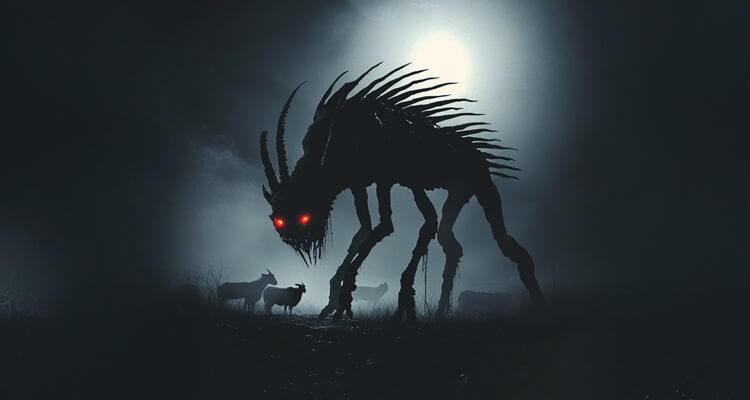
Few modern cryptids have captured the imagination quite like the Chupacabra. First reported in Puerto Rico during the 1990s, this mysterious creature quickly became one of the world’s best-known urban legends. Stories described livestock found dead with strange puncture wounds and little blood remaining, giving rise to the name Chupacabra, or “goat-sucker.”
Whether viewed as an undiscovered animal, a case of mistaken identity, or a reflection of cultural fears, the Chupacabra has become much more than a monster story. Its legend offers a fascinating look at how folklore evolves, how media shapes public belief, and why mysterious creatures continue to capture our imagination.
Where the Chupacabra Legend Began
The Chupacabra first entered the public eye in Puerto Rico in 1995 after a series of unusual livestock deaths.
Goats, chickens, and other farm animals were reportedly discovered with puncture wounds and little visible blood. Witnesses soon began describing a strange creature responsible for the attacks. Early reports portrayed it as reptilian, with glowing red eyes, sharp spines running down its back, and an unsettling, almost alien appearance.
News coverage spread the story rapidly. As reports appeared throughout Latin America, the United States, and eventually Europe, the creature’s appearance began to change. In some regions it remained reptilian, while in others it became a hairless, dog-like animal roaming rural landscapes.
Like many legends, the Chupacabra adapted to the communities telling its story.
Could There Be a Scientific Explanation?
Although the legend remains popular, most scientists believe there are more ordinary explanations behind reported sightings.
Many alleged Chupacabras have turned out to be coyotes, foxes, or stray dogs suffering from severe mange. Hair loss, malnutrition, and illness can dramatically alter an animal’s appearance, making it look unfamiliar, especially when seen briefly at night.
Livestock deaths can often be explained by known predators, scavengers, or disease. Blood pooling inside the body after death may also create the impression that an animal has been completely drained, even when that isn’t actually the case.
None of these explanations are as dramatic as a legendary cryptid, but they demonstrate how unusual events can quickly grow into enduring folklore.
A Monster That Reflects Cultural Fears
The Chupacabra is interesting not only because of what people claim to have seen, but because of what the legend represents.
In Puerto Rico, some scholars have suggested the creature reflected broader anxieties surrounding economic hardship, political uncertainty, and the island’s relationship with the United States. Others have interpreted the blood-drinking monster as a symbol of exploitation or the fear of outside influence.
As the story spread, different communities adapted it to reflect their own concerns.
Like many legendary creatures, the Chupacabra became a canvas onto which people projected their fears, frustrations, and unanswered questions.
How the Media Created a Global Legend
Without television and newspapers, the Chupacabra might never have become internationally famous.
Reports of mysterious livestock deaths received widespread coverage, often accompanied by dramatic illustrations and eyewitness interviews. Each retelling added new details, making the creature seem even more terrifying.
The internet only accelerated its growth.
Websites, forums, documentaries, YouTube videos, podcasts, and social media introduced the Chupacabra to entirely new audiences. Photos of diseased animals were shared as “proof,” while new sightings appeared across countries where the legend had never previously existed.
The Chupacabra became a modern example of how folklore now spreads at internet speed.
Why People Still Believe
Cryptids occupy an unusual space between science and storytelling.
For believers, the lack of definitive evidence leaves room for possibility. For skeptics, the absence of reliable proof makes ordinary explanations more convincing.
Neither perspective has diminished public fascination.
The Chupacabra continues to appear in books, television, films, games, and paranormal investigations because it represents something people have always found compelling: the possibility that there are still mysteries waiting to be explained.
Why the Chupacabra Endures
The Chupacabra has survived for more than three decades because it speaks to something larger than livestock attacks.
It reminds us that folklore doesn’t stop evolving simply because we live in the modern world. New legends continue to emerge, shaped by news coverage, popular culture, and our natural curiosity about the unknown.
Whether you see the Chupacabra as an undiscovered creature, a cultural metaphor, or an unforgettable urban legend, it has earned its place alongside the great monsters of modern folklore. Sometimes the most fascinating part of a legend isn’t whether it’s true. It’s why so many people want to believe it might be.
Curious about the darker side of history and folklore?
If you enjoyed this article, there are plenty more mysteries waiting to be explored. Browse our growing collection of folklore, gothic history, cryptids, literature, films, and places that celebrate the darker corners of culture.
If you’d like to help Love of Gothic continue growing, consider joining us on Patreon. Prefer another way to support the community? Share an article with a friend, favourite the listings you enjoy, leave reviews where you can, or recommend Love of Gothic to fellow fans of the strange and unusual.
Every visit, recommendation, and conversation helps this community grow. Thanks for exploring it with us.