

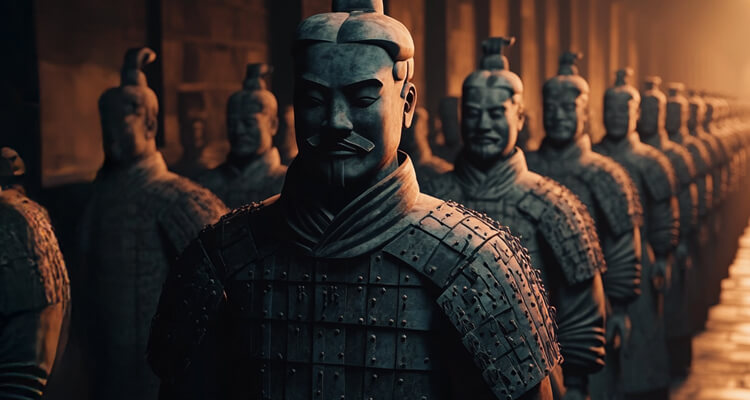
Few archaeological discoveries inspire as much wonder as the Terracotta Army. Hidden beneath the earth for more than 2,000 years, thousands of life-sized clay soldiers stand in silent formation near the tomb of China’s first emperor. Their expressions are calm, their weapons ready, and their purpose unchanged since the third century BCE.
Discovered by chance in 1974, the Terracotta Army offers an extraordinary glimpse into the ambitions of Emperor Qin Shi Huang and the beliefs that shaped ancient China. More than an artistic achievement, it reflects ideas about power, the afterlife, and the desire to leave a legacy that would outlast death itself.
An Emperor Determined to Rule Forever
The story of the Terracotta Army begins with Emperor Qin Shi Huang.
Ascending the throne at just thirteen years old in 246 BCE, Qin eventually unified China’s warring states and became the country’s first emperor. His reign transformed China through sweeping reforms, including standardized currency, weights and measures, and a common writing system. Construction of the earliest sections of what would become the Great Wall also began during his rule.
Alongside these accomplishments, Qin developed a deep fascination with immortality.
Ancient Chinese beliefs held that the afterlife mirrored the living world. Rather than leaving his empire behind, Qin intended to continue ruling after death. His enormous mausoleum was designed as an underground kingdom, complete with palaces, officials, treasures, and an army prepared to defend him for eternity.
Building this vast complex required an estimated 700,000 workers, making it one of the largest construction projects of the ancient world.
A Discovery Hidden for More Than Two Millennia
The Terracotta Army remained buried until 1974, when local farmers digging a well near Xi’an uncovered fragments of a clay figure.
Archaeologists soon realized they had discovered something extraordinary.
Excavations revealed a massive underground complex covering more than 22 square miles. So far, archaeologists have identified over 8,000 soldiers, around 130 chariots, hundreds of horses, and numerous officials, musicians, and other figures connected to the emperor’s burial complex. Many parts of the site remain unexcavated today.
Each discovery has added another piece to our understanding of one of history’s most ambitious burial projects.
No Two Soldiers Are Exactly Alike
One of the most remarkable aspects of the Terracotta Army is the individuality of its figures.
Although craftsmen used standardized molds to produce many body parts efficiently, every soldier was finished by hand. Faces, hairstyles, armour, facial hair, and expressions vary from one figure to the next, creating the impression that each represents a real member of Qin’s army.
Rank is reflected in the details.
Generals stand taller than ordinary soldiers. Officers wear more elaborate armour, while archers, cavalry, and infantry each display equipment suited to their role on the battlefield.
Originally, these figures were anything but the familiar terracotta colour seen today.
They were painted in vibrant reds, blues, greens, purples, and yellows. Unfortunately, exposure to air during excavation caused much of the original paint to deteriorate within hours, leaving only small traces behind.
The Tomb Beneath the Army
The famous soldiers are only one part of a much larger mausoleum.
At its centre lies the burial chamber of Emperor Qin Shi Huang, which remains unopened.
Ancient historian Sima Qian described the tomb as containing rivers and seas of flowing mercury beneath a ceiling decorated with stars. Modern archaeological surveys have detected unusually high concentrations of mercury in the surrounding soil, lending some support to these ancient accounts.
For now, the central tomb remains sealed.
Archaeologists believe today’s technology may not yet be capable of preserving everything inside without causing irreversible damage. Rather than risk destroying priceless artifacts, they have chosen to leave the emperor’s burial chamber undisturbed until better preservation methods become available.
What the Terracotta Army Reveals About Ancient China
The Terracotta Army provides an extraordinary snapshot of the Qin Dynasty.
It reveals how the military was organized, what soldiers wore, the weapons they carried, and the remarkable craftsmanship achieved more than two thousand years ago.
It also reflects the emperor’s view of power.
Rather than preparing only for death, Qin Shi Huang planned for continued rule beyond it. His army was intended to protect him just as living soldiers had during his lifetime.
This belief transformed an imperial tomb into one of history’s greatest archaeological treasures.
Preserving an Ancient Wonder
Protecting the Terracotta Army presents ongoing challenges.
Changes in temperature, humidity, and exposure to light all threaten the fragile clay figures and the remaining traces of their original paint. Every new excavation must balance the excitement of discovery with the responsibility of long-term preservation.
Researchers now use 3D scanning, detailed digital mapping, advanced conservation techniques, and climate-controlled excavation areas to document and protect the site.
Excavation continues slowly, with each newly uncovered figure helping historians better understand both the mausoleum and the civilization that created it.
Why the Terracotta Army Still Captivates Us
The Terracotta Army is more than an impressive collection of statues.
It represents one ruler’s determination to carry his authority into eternity, while offering modern visitors an extraordinary window into the beliefs, technology, and artistry of ancient China.
For lovers of gothic history, there is something especially compelling about thousands of silent guardians standing watch over an emperor who believed death was simply another kingdom to govern. Their stillness is haunting, but their purpose remains unmistakable.
More than two thousand years after they were created, the Terracotta Army continues to remind us that some of history’s greatest monuments were built not for the living, but for the dead.
Fascinated by history’s darker stories?
Love of Gothic explores the people, places, legends, and artifacts that continue to shape our understanding of the past. If you enjoyed this article, you’ll find plenty more to discover throughout our history, folklore, and gothic culture collections.
If you’d like to support what we’re building, becoming a Patreon member helps us create more original content and continue expanding the site. Another great way to help is by sharing your favourite articles, recommending Love of Gothic to fellow history lovers, leaving reviews where you can, and favouriting the listings you enjoy.
Every reader helps keep these stories alive. Thanks for exploring them with us.