

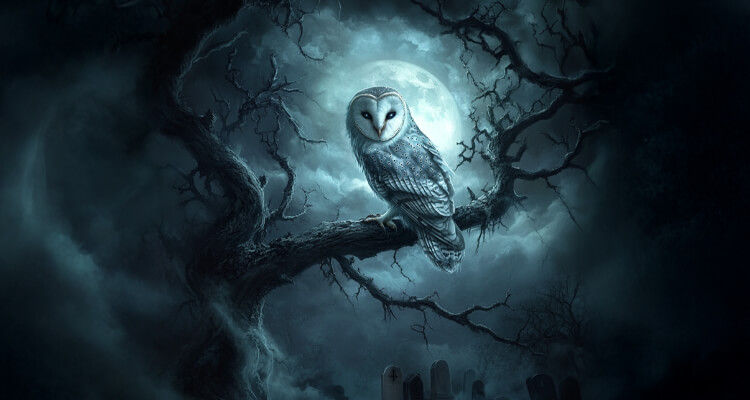
Few birds feel as perfectly at home in gothic imagery as the barn owl (Tyto alba). Its pale, heart-shaped face, silent flight, and eerie calls have inspired myths and folklore for centuries. Yet the real bird is even more fascinating than the legends.
Barn owls are among nature’s most skilled hunters. They can catch prey in near total darkness, fly so quietly that they are almost impossible to hear, and strike with remarkable accuracy. Every part of their body has evolved to help them succeed after sunset, making them one of the most effective nocturnal predators in the world.
How Barn Owls Hunt Without Light
Most predators rely heavily on their eyesight, but barn owls have another advantage. They hunt primarily by sound.
Their ears sit at slightly different heights on either side of their head. This unusual arrangement allows them to detect tiny differences in when and how a sound reaches each ear. Their brain uses that information to build a three dimensional picture of where prey is hiding.
Their distinctive facial disc helps too. The stiff, rounded feathers surrounding the face act like a satellite dish, directing even the faintest sounds toward the owl’s ears.
The result is extraordinary accuracy. A mouse rustling beneath long grass or even under a layer of snow can often be located without the owl ever seeing it.
The Secret Behind Their Silent Flight
Barn owls are famous for their ghost-like flight, and that reputation is well deserved.
Unlike most birds, the leading edges of their wing feathers have tiny comb-like fringes that break up the airflow. Combined with their soft, velvety plumage, these feathers dramatically reduce the sound created during flight.
Their broad wings also allow them to glide slowly with very little flapping. Instead of rushing toward their target, they seem to drift through the night almost effortlessly.
For prey, that silence can mean there is little warning before the owl arrives.
A Strike That Leaves Little Room for Error
Once a barn owl has located its target, everything happens quickly.
The owl may hover briefly while making small adjustments to its position. When the moment is right, it drops with speed and precision, extending its powerful, curved talons at the last second.
These strikes are accurate enough to capture prey hiding beneath vegetation or light snow. If an animal changes direction, the owl can often adjust its flight in midair before making contact.
That combination of patience, precision, and speed makes every hunt a carefully calculated effort rather than a simple chase.
Built to Adapt
Although barn owls are best known as nocturnal hunters, they are more flexible than many people realize.
They occasionally hunt during daylight, especially when feeding young chicks or when food is difficult to find. They also thrive in a wide range of habitats, including grasslands, forests, wetlands, and farmland.
Agricultural areas can be especially attractive because they support healthy rodent populations. In return, barn owls provide a valuable natural form of pest control, reducing the need for chemical solutions in many farming communities.
Their willingness to adapt has helped them spread across much of the world, making them one of the most widely distributed owl species.
Anatomy Designed for Hunting
A barn owl’s hunting success comes from several adaptations working together.
Its exceptional hearing helps locate prey hidden from view. Large eyes provide excellent vision in low light. Long wings create slow, controlled flight, while powerful talons grip prey securely once a strike is made.
None of these features is especially impressive on its own. Together, they create a predator that is perfectly suited to life after dark.
Why Barn Owls Continue to Fascinate
Barn owls remind us that some of nature’s most impressive abilities happen when the world is asleep. They do not rely on speed alone or overwhelming strength. Instead, they succeed through patience, precision, and a remarkable collection of evolutionary adaptations that have been refined over millions of years.
Perhaps that’s one reason they have remained such enduring symbols in gothic culture. Their silent flight, pale appearance, and mysterious nighttime habits naturally capture the imagination. Once you understand how they hunt, though, it becomes clear that the real barn owl is every bit as extraordinary as the stories told about it.
If you find yourself looking up at the night sky after reading this, keep an ear out. You probably won’t hear a barn owl flying overhead, and that’s exactly the point.
Enjoying Love of Gothic?
Love of Gothic is built by volunteers who simply love sharing gothic culture in all its forms. If you’d like to help us keep creating articles, directories, recipes, and resources for the community, becoming a Patreon member is one of the best ways to support our work.
Not in a position to contribute financially? You can still make a huge difference. Share Love of Gothic with friends, recommend the site in your favourite communities, leave reviews where you can, favourite the listings you enjoy, and help us grow a community that celebrates gothic culture in all its forms.
However you choose to support us, thank you for being part of the community.