
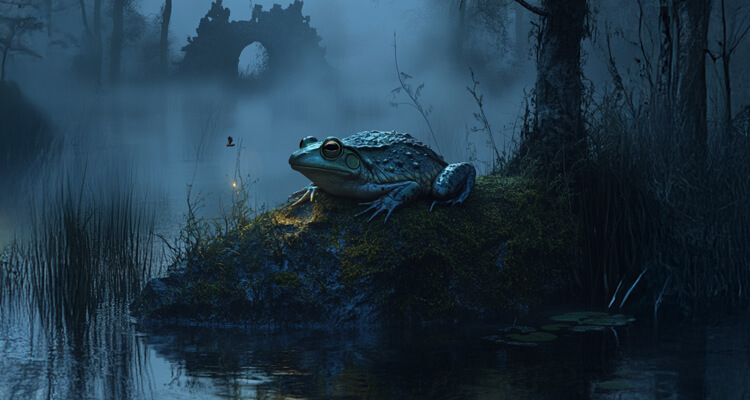
Why do frogs, toads, and salamanders appear so often in stories about witches, haunted marshes, and forgotten magic? They’re rarely the stars of the tale, yet they linger in the background of gothic literature as symbols of change, mystery, and the unknown. Their unusual life cycles and ability to move between water and land have made them powerful metaphors for transformation, while centuries of folklore have tied them to the supernatural.
Whether lurking in a moonlit swamp or appearing beside an alchemist’s workbench, amphibians occupy a unique place in gothic storytelling. They blur boundaries between worlds, reminding us that some of the genre’s most enduring symbols are also some of nature’s most fascinating creatures.
Symbols of Transformation
Few animals embody transformation as completely as amphibians.
A tadpole begins life as an entirely aquatic creature before gradually developing legs, lungs, and a completely different way of living. This remarkable metamorphosis has made amphibians natural symbols of change across mythology, folklore, and literature.
Gothic fiction often explores characters who undergo dramatic physical, emotional, or spiritual transformations. Curses, monstrous identities, forbidden knowledge, and fractured personalities all reflect the same themes of becoming something new, sometimes willingly and sometimes against one’s will.
Amphibians quietly reinforce these ideas. Their life cycle reminds readers that transformation can be both beautiful and unsettling, carrying the promise of growth while demanding the loss of what came before.
Living Between Two Worlds
The Gothic has always been fascinated by thresholds.
Its stories exist between life and death, reason and madness, reality and the supernatural. Amphibians fit naturally into this tradition because they spend their lives crossing boundaries that few other animals can.
Living comfortably in both water and on land, they resist simple classification. That liminal existence mirrors the uncertain spaces where many gothic stories unfold.
It’s no coincidence that frogs, toads, and salamanders frequently appear in marshes, wetlands, and mist-covered ponds. These landscapes already feel suspended between worlds, making them ideal settings for stories where the ordinary slowly gives way to the uncanny.
Folklore, Superstition, and the Uncanny
Long before gothic literature embraced amphibians, folklore had already given them mysterious reputations.
Throughout Europe, toads were commonly associated with witchcraft, curses, and poisonous magic. Salamanders developed an equally unusual reputation after ancient writers claimed they could survive fire, transforming them into symbols of resilience, transformation, and hidden knowledge.
Many of these beliefs had little basis in reality, but they proved remarkably durable.
By the time gothic writers began drawing upon older folklore, amphibians already carried centuries of symbolic meaning. Their quiet, nocturnal habits and unusual appearance made them ideal companions for stories exploring superstition, fear, and the unknown.
Amphibians and the Occult
Alchemy and occult traditions further strengthened the connection.
Historical texts frequently included toads, salamanders, and other amphibians among the symbolic ingredients of magical rituals and alchemical experiments. Whether viewed as literal components or symbolic representations, they became associated with transformation, hidden knowledge, and the pursuit of impossible goals.
The salamander became especially important in alchemical symbolism because of its legendary connection with fire. It represented purification through hardship, a theme that appears repeatedly throughout gothic fiction.
Meanwhile, toads often appeared as familiars, creatures believed to assist witches or magical practitioners. These associations reinforced the amphibian’s place within gothic imagery long before modern horror adopted similar motifs.
More Than Symbols of Darkness
Although gothic literature often emphasizes the darker symbolism of amphibians, they also represent renewal.
Their annual cycles of growth, transformation, and emergence remind readers that change is a natural part of life. Even in stories filled with decay, haunted landscapes, and forgotten ruins, amphibians quietly suggest that renewal remains possible.
This balance between life and death, decay and rebirth, makes them particularly well suited to gothic storytelling.
Rather than representing evil itself, amphibians often symbolize transition, uncertainty, and the constant movement between one state of being and another.
Why Amphibians Still Belong in Gothic Stories
Amphibians rarely dominate gothic narratives, yet their symbolism continues to endure because it speaks directly to the themes at the heart of the genre.
They inhabit landscapes where certainty fades into mystery. They transform themselves in extraordinary ways. They carry centuries of folklore while remaining firmly rooted in the natural world.
For gothic readers, they remind us that the most compelling symbols often come from nature itself.
Sometimes the quietest creatures leave the deepest impression, waiting patiently beneath still water until the moment they emerge and reveal an entirely different form.
Every symbol has a story behind it.
If you enjoy exploring the hidden meanings woven through gothic literature, you’ll find many more articles covering folklore, symbolism, mythology, history, and the natural world throughout Love of Gothic.
Supporting Love of Gothic on Patreon helps us continue researching and creating new content, but there are plenty of other ways to help too. Share articles that inspire you, recommend the site to fellow gothic enthusiasts, favourite the listings you enjoy, and leave reviews where you can.
Every shared discovery helps keep these stories alive. Thanks for being part of the journey.