

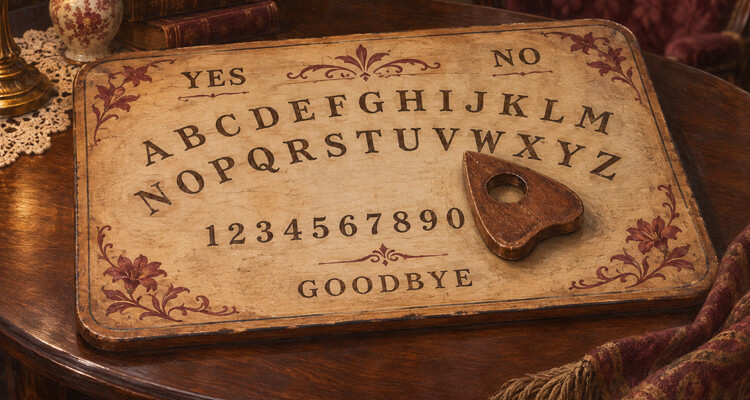
Few objects can make an ordinary table look quite so suspicious as a Ouija board. Its alphabet, numbers, and small moving pointer suggest that a conversation is possible, although who might be joining it depends very much on whom you ask.
The history of the Ouija board reaches back to nineteenth-century Spiritualism and a commercial product patented in 1891. Before horror films made it shorthand for an evening going badly wrong, it occupied an uncertain space between entertainment and belief.
That uncertainty is part of its appeal. A talking board brings together grief, curiosity, commercial ingenuity, and the unsettling experience of watching something move beneath your own fingers. The supernatural reputation is familiar. The human history deserves a closer look.
Spiritualism and the Desire to Hear from the Dead
The Ouija board emerged from a culture already interested in conversations with spirits. Spiritualism, a movement whose followers believed that the dead could communicate with the living, became prominent in the United States during the nineteenth century. Its practices included séances, where participants gathered in the hope of receiving messages, often through a medium who claimed to act as an intermediary. HISTORY’s account of the board’s origins places talking boards within this wider movement.
These gatherings could involve methods such as table-turning, with movements interpreted as responses to questions. A board marked with letters offered a more direct way to assemble words. Instead of waiting for an interpreter to explain a noise or gesture, participants could follow a pointer towards something that appeared to be a message.
The desire behind such messages was not always a taste for the macabre. Loss gave the possibility of contact a profound emotional weight. After the First World War and the influenza pandemic, interest in Spiritualism and talking boards rose among people hoping to hear from those who had died. HISTORY documents this renewed enthusiasm, alongside the criticism it attracted.
That context matters when looking back at the people around the table. Some were seeking entertainment, but others wanted reassurance that a relationship had survived death. Treating every participant as either a fool or a fraud leaves very little room for the complicated reasons people reach for answers.
The board made that hope tangible. Letters could be watched, movements could be followed, and several people could take part. Whether approached with conviction or curiosity, the experience gave an abstract question a remarkably simple physical form.
How a Talking Board Became a Commercial Product
Talking boards existed before the familiar Ouija brand. What changed in the late nineteenth century was the development of a recognisable commercial product. In Baltimore, Charles Kennard and other investors established the Kennard Novelty Company in 1890 to manufacture talking boards. Elijah Bond, a lawyer associated with the enterprise, applied for a patent. HISTORY traces this commercial development, including the people involved in bringing the product to market.
The surviving United States patent, number 446,054, was granted on February 10, 1891. Its description identifies an alphabet arranged on a board, numerals, affirmative and negative responses, and a small movable table or pointer. The operator placed a hand lightly on the pointer, which could indicate letters and form answers. Even through the formal language of a patent, the basic arrangement is easy to recognise.
The document is valuable because it gives the object’s history a firm point of reference. Here is a named applicant, a date, and a description of a manufactured device. None of that establishes that the answers came from spirits. A patent records an invention; it is not an endorsement from the afterlife, however useful that might have been for advertising.
The design also left room for different kinds of customers. A person could approach the board as a novelty, a social activity, or a possible means of communication. The physical object did not require everyone at the table to agree about what it meant.
That flexibility helps explain the fascination of its commercial beginnings. Something connected with intimate questions about death could also be packaged, sold, and brought home. Mystery had acquired a place on the shopping list.
The Uncertain Story Behind the Name Ouija
An object associated with mysterious messages has, appropriately enough, a name wrapped in a story of its own. A familiar explanation joins the French “oui” and German “ja,” both meaning yes. The historical account reported by Smithsonian Magazine offers a different origin, drawing on researcher Robert Murch’s work with the founders’ correspondence.
In that account, Helen Peters, Elijah Bond’s sister-in-law, asked the board what it should be called. The letters reportedly produced “Ouija,” followed by an explanation that the word meant good luck. Peters was also said to have been wearing a locket bearing a woman’s image and a name. One proposed explanation connects that name with the writer Ouida and a possible misreading. These details belong to a reported naming story, with uncertainties attached, rather than a settled demonstration of where every letter came from.
The distinction is worth keeping. The existence of correspondence describing an event does not make the supernatural interpretation of that event true. It tells us how people remembered or presented an episode. That is useful historical material, even when the episode refuses to become quite as tidy as we would like.
The name suits the product’s ambiguity. It is distinctive enough to recognise, yet unfamiliar enough to invite an explanation. Once a story becomes attached to it, even saying the word can feel like entering the atmosphere surrounding the board.
For a cultural history, that atmosphere matters. An uncertain origin can become part of an object’s identity, repeated alongside the instructions and remembered long after the details blur. We can enjoy the story while leaving its disputed pieces clearly labelled. Mystery survives perfectly well without assistance from confident misinformation.
What Makes the Planchette Move?
The small pointer used with a talking board is called a planchette. When people rest their fingers on it, its movement can feel as though it has begun independently. A psychological explanation involves ideomotor action: movements initiated without the person’s accompanying sense of deliberately choosing them. The movement can be real while the impression of its source is mistaken.
Researchers Hélène Gauchou, Ronald Rensink, and Sidney Fels used Ouija responses to investigate nonconscious knowledge in a 2012 study published in Consciousness and Cognition. Participants answered yes-or-no questions through deliberate reports and a Ouija procedure. Under the study’s conditions, answers participants believed were guesses were more accurate through the Ouija response than through deliberate reporting. The researchers interpreted this as evidence that ideomotor actions could express information unavailable to conscious recall.
That result is interesting within its actual limits. It does not mean that a board can reliably tell the future, reveal facts nobody knows, or deliver messages from the dead. The experiment concerned access to existing knowledge under controlled conditions. A memorable finding is still entitled to its original context.
The University of British Columbia’s Visual Cognition Lab describes this line of research as an investigation into conscious and unconscious knowledge. It turns an apparently supernatural object into a way of asking questions about the mind.
That explanation also allows us to take the experience seriously without accepting a spirit as its cause. Someone need not be consciously pushing the pointer as a joke to feel that it is moving beyond their control. The unsettling part may be the gap between an action and the awareness of producing it. Our own hands can be surprisingly poor witnesses.
How Horror Made the Board a Paranormal Icon
For many people, the Ouija board arrives in the imagination with a warning already attached. Horror cinema gives the familiar arrangement of letters and pointer an immediate dramatic purpose: someone asks a question, an answer appears, and curiosity becomes the beginning of trouble. The audience may recognise the danger before the characters have finished arranging the furniture.
The Exorcist, released in 1973, is an important part of that association. Its Ouija sequence links Regan with the presence she calls Captain Howdy. In Sight and Sound, critic Kim Newman places this sequence in the development of horror about young people making contact with dangerous supernatural forces, a pattern later films continued to explore.
As a storytelling device, the board is unusually economical. It gives something unseen a visible means of responding. A camera can linger on a letter, follow a movement, or hold on the faces of people trying to decide whether somebody else is responsible. The ordinary setting remains recognisable while its meaning changes. A table becomes the place where a boundary might have been crossed.
That is an interpretation of its dramatic appeal, rather than evidence that the object itself has supernatural power. The history of a film image and the history of a physical device overlap, but they answer different questions. Cinema can make a possibility unforgettable without making it factual.
The board’s enduring fascination sits between those histories. It can be a commercial novelty, a focus for belief, an instrument in a psychology experiment, and an image that makes a room feel less empty. For a gothic imagination, there is plenty to explore there. The letters remain quite ordinary. The stories people bring to them are anything but.
Enjoying Love of Gothic?
Love of Gothic is built by volunteers who simply love sharing gothic culture in all its forms. If you’d like to help us keep creating articles, directories, recipes, and resources for the community, becoming a Patreon member(opens in a new tab) is one of the best ways to support our work.
Not in a position to contribute financially? You can still make a huge difference. Share Love of Gothic with friends, recommend the site in your favourite communities, leave reviews where you can, favourite the listings you enjoy, and help us grow a community that celebrates gothic culture in all its forms.
However you choose to support us, thank you for being part of the community.