

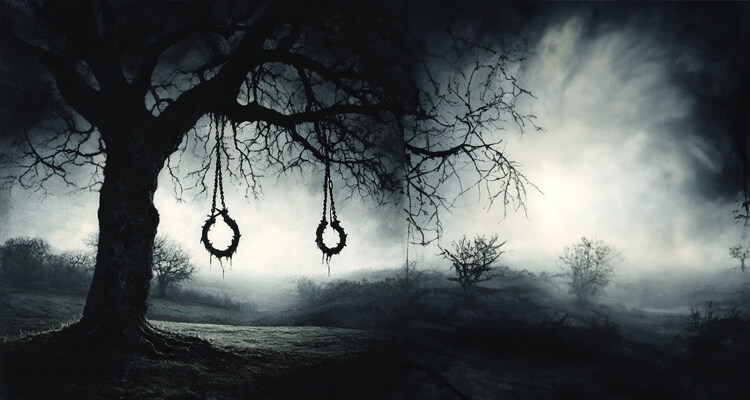
A tree is usually a symbol of life, growth, and renewal. Throughout history, however, some trees became remembered for something far darker.
Known as hanging trees, these landmarks served as sites of public executions, frontier justice, and, in many cases, acts of mob violence. Long after the executions ended, many remained standing, becoming silent witnesses to the communities that gathered beneath their branches. Today, hanging trees occupy a complicated place in history, remembered not only for the punishments they witnessed but also for the questions they raise about justice, power, and collective memory.
Public Executions and the Hanging Tree
For centuries, public executions formed part of the legal system in many countries.
In eighteenth and nineteenth-century Britain, executions were often carried out before large crowds. Whether at purpose-built gallows or beneath prominent trees, these events were intended to punish the condemned while discouraging others from committing similar crimes.
The execution itself became a public spectacle.
Thousands of people might gather to witness the event, turning punishment into a form of civic theatre. Authorities believed that public displays reinforced the rule of law, while many spectators attended out of curiosity or because executions became significant public events.
As attitudes toward justice gradually changed, public executions became increasingly controversial. By the late nineteenth century, many countries had moved executions behind prison walls, marking a major shift in how punishment was viewed.
Hanging Trees in the American Frontier
Hanging trees became especially associated with the American West.
In isolated settlements where formal courts were often distant or unavailable, suspected criminals were sometimes tried and executed by vigilante groups rather than legal authorities. While some communities viewed these actions as necessary, many executions took place without fair trials or meaningful evidence.
Over time, these trees became symbols of frontier justice.
In reality, they also reflected the dangers of lawlessness, prejudice, and communities taking justice into their own hands. Some hanging trees became associated with notorious outlaws, while others witnessed the execution of innocent people caught in moments of fear or social unrest.
Their history reminds us that justice carried out without accountability can quickly become injustice.
From Places of Death to Places of Memory
Many historic hanging trees no longer exist, but those that remain often serve as memorials rather than monuments.
Communities have preserved some of these locations to acknowledge difficult chapters in local history and encourage reflection rather than celebration.
In Finland, for example, the site of the country’s last official execution has been commemorated as part of its historical landscape. Similar efforts elsewhere have transformed former execution sites into places where visitors can learn about changing ideas of justice, human rights, and legal reform.
The meaning of these places has changed over time.
What was once intended to intimidate now often encourages remembrance and discussion.
The Hanging Tree in Religion and Symbolism
The image of the hanging tree carries symbolic meaning beyond its historical use.
Within Christian tradition, references to being “hanged on a tree” are connected to the crucifixion of Jesus and passages that describe such a death as carrying profound spiritual significance. These biblical references helped shape the tree into a symbol of sacrifice, judgment, suffering, and redemption.
Outside religious contexts, the hanging tree came to represent mortality, justice, and the consequences of human actions.
Because trees themselves often symbolize life, their use as places of execution created a powerful visual contrast that continues to resonate in art and literature.
Hanging Trees in Literature and Popular Culture
The hanging tree has remained a powerful image throughout literature, film, music, and folklore.
In gothic fiction, it often appears as a place where the past refuses to remain buried. Ghost stories frequently use hanging trees as settings where restless spirits linger, while historical novels employ them to explore themes of guilt, injustice, and memory.
The symbol also appears in medieval art, poetry, and modern storytelling, where it represents far more than execution alone.
It becomes a reminder that places can absorb stories, allowing history and legend to become intertwined until separating fact from folklore becomes almost impossible.
Why Hanging Trees Still Matter
Today, hanging trees invite reflection rather than fear.
They encourage us to examine how societies once understood justice, how public punishment shaped communities, and how legal systems have evolved over time. They also remind us that history is rarely simple. Many of these sites witnessed lawful executions, while others became locations of racial violence, lynching, or extrajudicial punishment that should never be forgotten.
For lovers of gothic history, hanging trees occupy a unique place where landscape, memory, and symbolism meet. Their branches have become woven into folklore not because of the trees themselves, but because of the human stories attached to them.
Long after the crowds have disappeared, the trees remain. Their silence invites us to remember not only those who died beneath them, but also the lessons history continues to teach about justice, power, and compassion.
History leaves its mark in unexpected places.
If you’re fascinated by forgotten landmarks, dark history, folklore, and the stories hidden behind ordinary places, you’ll find many more articles throughout Love of Gothic.
Supporting Love of Gothic on Patreon helps us continue researching and sharing these stories, but there are plenty of other ways to contribute. Share an article that surprised you, recommend the site to fellow history enthusiasts, favourite the listings you enjoy, and leave reviews where you can.
Every story remembered helps preserve another piece of the past. Thanks for exploring history with us.