

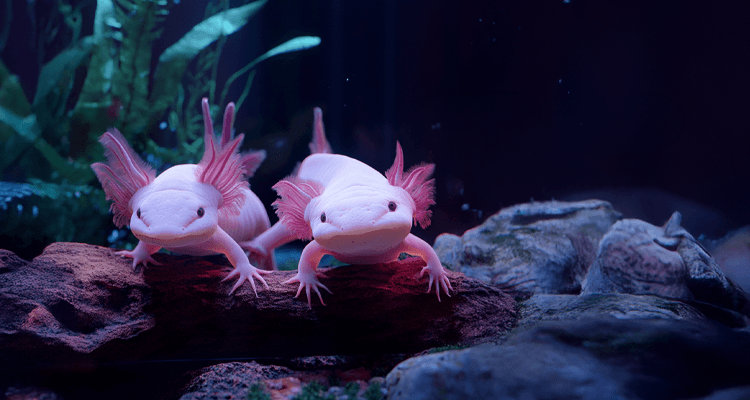
With their feathery gills, permanent smile, and almost mythical appearance, axolotls (Ambystoma mexicanum) hardly look like survivors. Yet beneath that gentle exterior is an animal equipped with a remarkable set of instincts that has helped it endure for thousands of years.
Unlike most amphibians, axolotls spend their entire lives underwater, never fully transforming into their adult form. To thrive in this environment, they rely on stealth, sharp senses, and one of the most extraordinary healing abilities in the animal kingdom. Every behavior, from the way they hunt to how they avoid danger, has evolved to give them the best possible chance of survival.
Today, those instincts are being tested by pollution, habitat loss, and climate change. Understanding how axolotls survive in the wild helps us appreciate both their incredible resilience and the challenges they now face.
Staying Hidden Is Their Best Defense
Axolotls are not built to outrun predators or fight them off. Instead, they avoid danger by staying out of sight.
When they sense a threat, they become almost perfectly still and retreat beneath aquatic plants, fallen branches, or rocky crevices. Researchers have found that they even respond to chemical signals released by predatory fish, allowing them to recognize danger before they see it.
Their appearance helps as well. The delicate external gills that make axolotls so recognizable sway gently in the water, blending surprisingly well with surrounding vegetation. Remaining unnoticed is often their greatest advantage.
If a predator does make contact, axolotls instinctively pull their gills and limbs close to their body to reduce the chance of injury.
The Animal That Can Grow Back What It Loses
Even careful animals cannot avoid every attack.
One of the axolotl’s most famous survival traits is its ability to regenerate damaged body parts. Lost limbs, sections of the tail, parts of the spinal cord, and even portions of the heart can regrow after injury.
This doesn’t make axolotls invincible, but it does give them a second chance after encounters that would prove fatal for many other animals. In habitats filled with predators, that ability can mean the difference between surviving and disappearing from the population.
Patient Hunters With a Powerful Bite
Axolotls are predators themselves, although they hunt in a much quieter way than many people expect.
Rather than chasing prey, they wait for the right opportunity before rapidly opening their mouth. This creates a powerful suction that pulls worms, insects, small fish, and other prey directly inside.
They are surprisingly selective eaters. Softer foods are generally preferred, while hard or bitter items are often rejected. This selectiveness helps ensure they consume food that is easier to digest and provides the nutrition they need.
Cold water slows their metabolism, meaning they hunt less frequently during cooler periods. Even then, specialized mechanics in their jaw allow them to feed effectively despite slower muscle movement.
Built for Life Underwater
Unlike frogs and salamanders that eventually spend much of their lives on land, axolotls remain fully aquatic.
They swim by moving their long tail in smooth, wave-like motions while using their limbs mainly for balance and steering. This slow, controlled style of movement allows them to navigate through dense vegetation without wasting energy.
Studies of axolotls with neurological mutations have also revealed how important coordination is for survival. Animals with impaired balance or swimming control struggle to forage efficiently and become far more vulnerable to predators.
Researchers have also discovered evidence that axolotls favour one eye over the other depending on the task. Their left eye appears to play a greater role in spotting potential threats, while the right is used more often when locating prey. It’s a subtle adaptation, but one that may help them process information more efficiently.
Finding the Right Place to Hide
Where an axolotl chooses to spend its time is almost as important as how it behaves.
During the day, they seek out shaded areas with thick vegetation or other forms of cover. These sheltered spaces reduce the chance of being spotted while providing a safe place to rest between hunting periods.
This instinct remains strong even in captivity. Axolotls kept in aquariums with plants, caves, and hiding places generally show fewer signs of stress than those housed in bare tanks.
As wetlands continue to disappear, suitable shelter is becoming harder to find. Protecting these microhabitats is an important part of conserving wild populations.
Sensing a World They Can’t Always See
Although axolotls have functional eyesight, vision is only part of how they understand their surroundings.
They are highly sensitive to touch and waterborne chemical signals. A gentle touch on the back triggers an immediate defensive response, causing them to pull back their eyes and external gills. This reflex helps protect some of their most vulnerable body parts during an attack.
Chemical cues in the water also play a major role in everyday life. They help axolotls detect predators, locate food, and respond to changes in their environment, making these senses just as important as sight.
A Species Feeling the Heat
Axolotls evolved in cool freshwater lakes, and their bodies are adapted to stable temperatures.
As the water becomes warmer, they become increasingly stressed and attempt to escape the heat. Rising temperatures affect their behaviour, metabolism, and overall health, making climate change one of the greatest long-term threats to the species.
Habitat loss, pollution, and invasive species have already placed wild axolotls under enormous pressure. Warmer waters add another challenge to an already difficult fight for survival.
Why Axolotls Matter
Axolotls have become internet celebrities thanks to their unusual appearance, but there is far more to them than a permanently smiling face. Their behaviours reveal a species shaped by millions of years of evolution, relying on patience, stealth, and extraordinary biological adaptations to survive.
At the same time, they remind us that even the most remarkable animals have limits. Regeneration cannot repair disappearing wetlands, and instinct alone cannot overcome polluted waterways.
Learning about axolotls is also a reminder of how much there is still to discover. Every study uncovers new details about how these fascinating amphibians navigate their underwater world, and every conservation effort helps ensure future generations will have the chance to do the same.
Enjoying Love of Gothic?
Love of Gothic is built by volunteers who simply love sharing gothic culture in all its forms. If you’d like to help us keep creating articles, directories, recipes, and resources for the community, becoming a Patreon member is one of the best ways to support our work.
Not in a position to contribute financially? You can still make a huge difference. Share Love of Gothic with friends, recommend the site in your favourite communities, leave reviews where you can, favourite the listings you enjoy, and help us grow a community that celebrates gothic culture in all its forms.
However you choose to support us, thank you for being part of the community.