

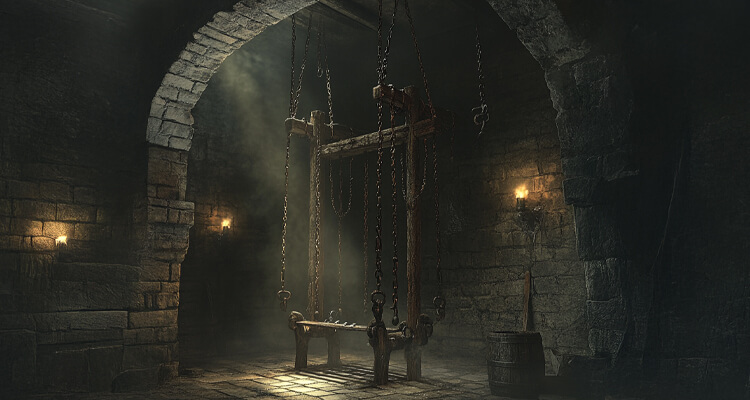
Few torture devices are as infamous as the rack. Its simple design concealed extraordinary brutality, making it one of history’s most recognizable symbols of coercion and abuse of power. Although it appears frequently in gothic fiction, horror films, and medieval fantasy, the real history of the rack is far more disturbing than its fictional portrayals.
Used for centuries to extract confessions, intimidate prisoners, and reinforce authority, the rack reveals how legal systems and religious institutions once justified cruelty in the pursuit of obedience. Its story is not simply about torture. It is about power, fear, and the consequences of unchecked authority.
Where the Rack Came From
Devices resembling the rack appeared in the ancient Greek and Roman worlds.
The Greeks used a stretching device sometimes described as a “torture ladder,” while the Romans developed the equuleus, a similar instrument used during interrogations, particularly in cases involving treason or serious crimes against the state.
The rack became far more widely associated with medieval Europe during the thirteenth century. As legal systems increasingly accepted torture as part of criminal investigations, the device evolved into one of the most feared methods of extracting confessions.
Its reputation grew further during the various inquisitions, where accusations of heresy or political disloyalty could lead to interrogation under torture.
How the Rack Worked
The rack’s design was deceptively simple.
A prisoner was tied by the wrists and ankles to a sturdy wooden frame fitted with rollers at each end. As the rollers turned, the victim’s body was slowly stretched.
The goal was rarely to kill immediately. Instead, interrogators carefully increased the tension over time, causing joints to dislocate, muscles and ligaments to tear, and intense pain to build while keeping the prisoner alive for continued questioning.
The slow, deliberate nature of the process made the rack especially terrifying. Every turn of the rollers offered another opportunity for a confession, whether truthful or not.
Torture as a Display of Power
The rack was never intended to remain hidden.
Executions and punishments often took place in highly visible settings, and torture itself could become part of a broader display of authority. The screams of prisoners, the sound of the wooden frame straining, and the presence of officials all reinforced the message that resistance carried severe consequences.
For rulers and governments, the device served two purposes.
It extracted information, or at least what interrogators believed to be information, while simultaneously warning everyone else what could happen to those who challenged authority.
Fear often proved just as effective as the torture itself.
The Rack During the Inquisition and Tudor England
The rack is closely associated with the various inquisitions in medieval and early modern Europe.
Although torture was governed by legal rules that varied between regions, the rack became one of several devices used during interrogations involving accusations of heresy. Church and secular authorities often viewed confessions as essential, even when those confessions were obtained under extreme physical pressure.
In England, the rack became particularly associated with the Tower of London during the reigns of Henry VIII and Elizabeth I.
Political prisoners, suspected spies, and individuals accused of treason sometimes faced the threat, or the reality, of the device. In many cases, the possibility of being placed on the rack was enough to pressure prisoners into cooperating before torture even began.
Why Torture Fell Out of Favor
By the eighteenth century, attitudes toward torture were beginning to change.
Thinkers of the Enlightenment questioned both its morality and its usefulness. Philosophers including Voltaire and Montesquieu argued that confessions obtained through extreme pain were unreliable and that justice should be guided by evidence rather than suffering.
Legal reforms gradually followed across Europe.
As judicial systems evolved, torture became increasingly viewed as incompatible with emerging ideas about human rights and due process. Devices like the rack shifted from accepted legal tools to symbols of a darker chapter in history.
More Than a Torture Device
The rack left behind more than physical scars.
Its greatest impact may have been psychological. The knowledge that authorities possessed such a device created an atmosphere of fear that extended far beyond the interrogation chamber.
People living under governments that sanctioned torture understood that accusations alone could have devastating consequences. In that sense, the rack became a symbol of absolute power as much as an instrument of physical pain.
Its legacy also raises difficult questions about those who carried out torture. Historical records suggest that some executioners and interrogators viewed their work as a duty, while others struggled with the emotional burden of inflicting suffering on another human being.
The Rack in Gothic Culture
Although the rack disappeared from legal systems centuries ago, it remains firmly embedded in popular culture.
It appears in gothic novels, horror films, historical dramas, haunted attractions, and museums, often representing the excesses of tyranny or the darkest moments of medieval justice. While these depictions are sometimes exaggerated, they reflect the lasting power of the rack as a cultural symbol.
For gothic storytelling, the rack represents more than physical suffering. It reminds us how fear can become a tool of control and how institutions can justify extraordinary cruelty when accountability disappears.
Why the Rack Still Matters
The rack belongs to history, but the questions it raises remain surprisingly modern.
How far should governments go when seeking information? Can justice exist when fear replaces fairness? What happens when institutions value obedience more than human dignity?
These questions explain why the rack continues to appear in books, films, museums, and discussions of legal history. It stands as a reminder that the greatest danger was never the machine itself. It was the belief that causing suffering could somehow produce truth.
Remembering the history of the rack is uncomfortable, but it also reminds us why modern legal systems place such importance on human rights, due process, and protections against torture. Some of history’s darkest inventions have become some of its most important lessons.
Enjoying Love of Gothic?
Love of Gothic is built by volunteers who simply love sharing gothic culture in all its forms. If you’d like to help us keep creating articles, directories, recipes, and resources for the community, becoming a Patreon member is one of the best ways to support our work.
Not in a position to contribute financially? You can still make a huge difference. Share Love of Gothic with friends, recommend the site in your favourite communities, leave reviews where you can, favourite the listings you enjoy, and help us grow a community that celebrates gothic culture in all its forms.
However you choose to support us, thank you for being part of the community.