

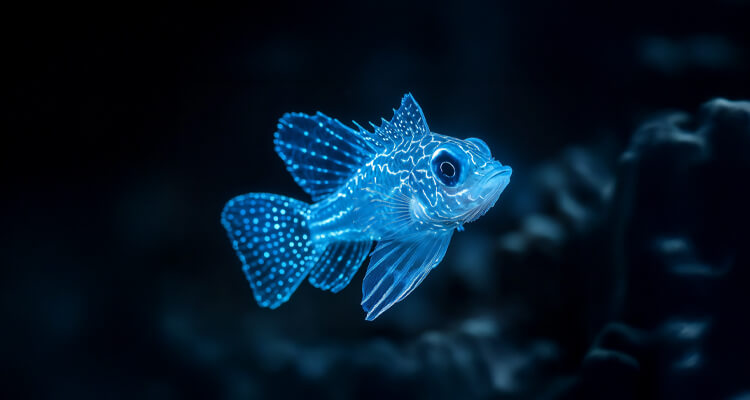
Far below the reach of sunlight lies a world that seems almost impossible. In the deep ocean, darkness is nearly absolute, temperatures hover just above freezing, and the pressure is immense. Yet this seemingly empty realm is filled with flashes of blue, green, and even red light produced by the animals that live there.
This natural phenomenon, known as bioluminescence, is one of the ocean’s most remarkable adaptations. Deep-sea creatures use light to hunt, communicate, hide from predators, and find mates in an environment where vision is limited and survival depends on every advantage.
How Living Creatures Produce Light
Bioluminescence is created through a chemical reaction inside an organism’s body.
The process typically involves a light-producing molecule called luciferin and an enzyme known as luciferase. When these compounds react in the presence of oxygen, they produce light with very little heat. This efficiency is especially valuable in the cold depths of the ocean, where conserving energy is essential.
Although many deep-sea animals use similar chemical compounds, the exact combinations vary between species. Different forms of luciferase and related molecules produce distinctive colours, brightness levels, and flashing patterns that have evolved to suit each animal’s needs.
Every Flash Has a Purpose
In the deep sea, light is a language.
Many animals produce unique patterns that help them recognize members of their own species and locate potential mates. Lanternfish, for example, use rows of tiny light-producing organs called photophores to communicate with one another. Dragonfish create their own distinctive displays, allowing them to identify suitable mates in an otherwise featureless environment.
These glowing patterns also help maintain reproductive isolation by ensuring that closely related species recognize the correct partners.
What appears to us as a beautiful display is often a highly specialized form of communication.
Light as a Survival Tool
Bioluminescence helps deep-sea animals survive in several different ways.
Some species use sudden flashes of light to startle predators or distract them long enough to escape. Certain jellyfish and other gelatinous animals produce bursts of light when threatened, creating confusion in the darkness.
Others use light offensively.
Anglerfish are perhaps the best-known example. Their glowing lure, called an esca, attracts curious prey close enough to be captured in a sudden strike. Siphonophores employ similar tactics, dangling glowing structures that resemble easy meals to unsuspecting fish.
In the deep ocean, light can be both an invitation and a trap.
Evolution in a World Without Sunlight
Life in permanent darkness has driven some extraordinary evolutionary adaptations.
Many deep-sea species have developed ultra-black skin that absorbs almost all incoming light, helping them disappear into the surrounding darkness. This camouflage makes it much harder for predators or prey to detect them, even when nearby organisms produce bioluminescent light.
Dragonfish have evolved an even more unusual ability.
While most deep-sea animals produce blue or green light, some dragonfish generate far-red bioluminescence. Because very few other marine animals can detect this wavelength, it functions almost like a private flashlight, allowing dragonfish to search for prey without revealing their presence.
These innovations highlight how evolution continues to find creative solutions in even the harshest environments.
The Hidden Engine of Deep-Sea Ecosystems
Bioluminescence is far more than an unusual curiosity.
Scientists estimate that roughly three quarters of deep-sea animals produce some form of bioluminescence, making it one of the defining characteristics of life below the ocean’s surface.
These glowing interactions support complex food webs by helping predators locate prey, allowing prey to escape danger, and enabling individuals to find mates across vast distances.
Researchers have also found that bioluminescent activity tends to increase in structurally complex habitats near the seafloor, where reefs, rocky outcrops, and other features create opportunities for communication, hunting, and camouflage.
In many ways, light serves as the foundation for an ecosystem that exists almost entirely without sunlight.
Why Bioluminescence Continues to Fascinate
Few natural phenomena capture the imagination quite like living light.
Bioluminescent animals transform one of Earth’s darkest environments into a landscape filled with flashes, pulses, and glowing signals that remain largely hidden from human eyes. Every shimmer represents an ancient survival strategy refined over millions of years.
For lovers of gothic beauty, the deep ocean offers a reminder that mystery doesn’t exist only in abandoned castles or moonlit forests. Some of the world’s most extraordinary wonders drift silently through an endless darkness, carrying their own light wherever they go.
The deeper we explore the ocean, the more we discover that its greatest secrets are still waiting beneath the waves.
Drawn to nature’s darker wonders?
From mysterious wildlife and forgotten history to folklore, art, and the unusual corners of the natural world, Love of Gothic celebrates the stories that thrive just beyond the ordinary.
If you’d like to help us keep uncovering them, consider supporting Love of Gothic on Patreon. You can also help by sharing articles you enjoy, recommending the site to fellow curious minds, leaving reviews where you can, and favouriting the listings that inspire you.
Every reader helps shine a little more light into the unknown. Thanks for exploring it with us.