

Plants aren’t supposed to hunt. At least, that’s what most of us assume. We picture them quietly drawing nutrients from the soil and sunlight from the sky, rooted in place and harmless to anything that wanders past.
Carnivorous plants ignore those expectations entirely.
Growing in some of the world’s most nutrient-poor environments, these remarkable species evolved an extraordinary solution to a difficult problem. Instead of relying solely on the soil beneath them, they began capturing insects and other small animals, digesting them to obtain the nutrients they couldn’t find elsewhere. The result is one of nature’s most fascinating examples of adaptation, where beauty and predation exist side by side.
Traps Designed by Evolution
Carnivorous plants don’t all hunt the same way.
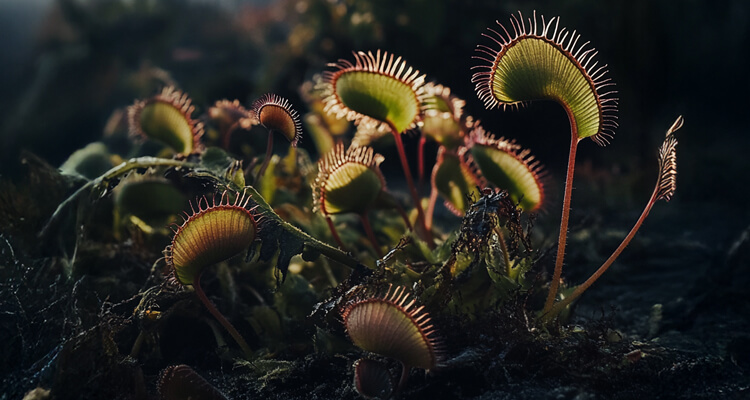
The Venus flytrap is perhaps the most famous. Its modified leaves snap shut in a fraction of a second after tiny trigger hairs are touched multiple times, helping prevent the trap from closing unnecessarily on falling raindrops or debris.
Pitcher plants, including species from the genera Nepenthes and Sarracenia, take a different approach. Their tall, tube-shaped leaves attract insects with colour, scent, and nectar before guiding them into a slippery chamber filled with digestive fluid. Once inside, escape becomes extremely difficult.
Meanwhile, sundews (Drosera) rely on hundreds of glistening sticky tentacles. An insect that lands on the leaf quickly becomes trapped, and the plant slowly curls around its prey before beginning digestion.
Each trap reflects a different evolutionary solution to the same challenge: surviving where nutrients are in short supply.
Turning Prey Into Plant Food
Capturing prey is only half the process.
Once an insect has been trapped, carnivorous plants release digestive enzymes that break down soft tissues into nutrients the plant can absorb. Proteases digest proteins, while phosphatases help release phosphorus, two resources that are often scarce in the bogs, marshes, and wetlands where many carnivorous plants grow.
Different species have developed slightly different strategies.
Venus flytraps seal tightly around their prey to create a temporary digestive chamber. Pitcher plants allow digestive fluids to slowly dissolve insects that fall into their traps. Sundews combine sticky secretions with digestive enzymes, turning each leaf into both a trap and a stomach.
These nutrients supplement, rather than replace, photosynthesis. Carnivorous plants still produce energy from sunlight like other plants. Hunting simply helps them overcome the limitations of poor soil.
Why Plants Became Carnivores
Carnivorous plants evolved independently in several unrelated plant groups, making them one of the clearest examples of convergent evolution.
Although they developed in different parts of the world, many arrived at remarkably similar solutions because they faced the same environmental challenge.
Their habitats often contain plenty of sunlight and water but very little nitrogen or phosphorus. Building traps requires energy, so carnivorous plants generally grow in bright, open environments where photosynthesis can provide the resources needed to support these specialized structures.
The benefits outweigh the cost. By capturing insects, these plants gain nutrients unavailable to most neighbouring vegetation, allowing them to survive where many other species cannot.
Evolution Recycles What Already Works
One of the most fascinating discoveries about carnivorous plants comes from their genetics.
Many of the enzymes used to digest insects appear to have evolved from proteins that originally helped plants defend themselves against disease. Rather than evolving entirely new biological systems, evolution repurposed existing tools for an entirely different job.
Researchers have also found that many digestive genes remain inactive until prey is captured. This allows the plant to conserve energy, producing digestive enzymes only when they’re actually needed.
It’s an elegant example of how evolution often modifies existing structures instead of starting from scratch.
Solving a Curious Problem
Carnivorous plants depend on insects for food.
Many also depend on insects for pollination.
At first glance, that seems like a dangerous contradiction. Capturing too many pollinators could reduce the plant’s ability to reproduce.
Fortunately, evolution solved that problem too.
Many pitcher plants position their flowers well above their traps, reducing the chance that visiting pollinators become accidental meals. Other species bloom at times when prey capture is naturally lower or produce flowers that attract different insects than those targeted by their traps.
This careful separation allows carnivorous plants to remain both successful predators and successful flowering plants.
More Than Botanical Curiosities
Carnivorous plants often capture our attention because they seem to blur the boundary between plant and predator.
Yet they also play important ecological roles.
Their traps regulate insect populations while creating tiny habitats for microorganisms and specialized insects that have adapted to live inside pitcher plants without being digested. Rather than existing outside the ecosystem, carnivorous plants are deeply connected to it.
Because many species rely on healthy wetlands, they are also vulnerable to habitat loss, pollution, and climate change. Protecting bogs, marshes, and other wetlands helps preserve not only these remarkable plants but entire ecosystems built around them.
Why Carnivorous Plants Continue to Fascinate
Few organisms challenge our expectations quite like carnivorous plants.
They remind us that evolution doesn’t follow the rules we imagine. Faced with difficult conditions, life finds unexpected solutions, sometimes transforming quiet, rooted plants into highly specialized hunters.
For lovers of gothic nature, there’s something especially captivating about their quiet patience. They don’t chase their prey or roar through the forest. They simply wait, hidden among mosses and reeds, until the perfect moment arrives.
Nature’s most effective predators aren’t always the ones with teeth.
The natural world is stranger than fiction.
If you enjoyed learning about carnivorous plants, you’ll find many more articles exploring unusual wildlife, forgotten folklore, gothic history, and the fascinating corners of nature throughout Love of Gothic.
If you’d like to support what we do, joining us on Patreon helps us continue creating new content. You can also help by sharing your favourite articles, recommending Love of Gothic to curious friends, favouriting the listings you enjoy, and leaving reviews where you can.
Every new reader helps these remarkable stories take root. Thanks for growing the community with us.