

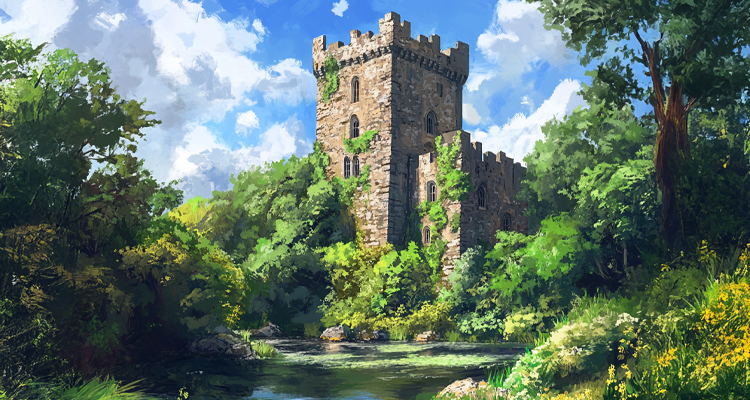
Every year, hundreds of thousands of people willingly lean backward over the edge of a medieval castle, trusting a metal railing and a stranger’s grip so they can kiss a weathered block of limestone.
The reward, according to legend, is the gift of eloquence.
For centuries, the Blarney Stone has drawn visitors from around the world hoping to receive the famous “gift of the gab.” Yet beneath that lighthearted tradition lies a deeper collection of legends involving ancient goddesses, royal alliances, supernatural curses, and centuries of Irish storytelling. The Blarney Stone is more than a tourist attraction. It is one of Ireland’s most enduring pieces of folklore.
Where Did the Blarney Stone Come From?
Like many legendary objects, the Blarney Stone has more than one origin story.
One of the best-known legends centres on Cormac Laidir MacCarthy, who built Blarney Castle during the fifteenth century. According to tradition, he sought the help of Clíodhna, a goddess from Irish mythology, before an important legal dispute. She instructed him to kiss a particular stone, granting him such remarkable eloquence that he won his case. In gratitude, MacCarthy placed the stone within the castle walls, where it remains today.
Another tradition links the stone to the Stone of Scone, the historic coronation stone of Scottish kings. According to this version, Robert the Bruce presented part of the stone to the MacCarthy family after the Battle of Bannockburn in 1314 as thanks for their support.
Whether rooted in mythology, history, or a blend of both, these stories have helped transform an ordinary piece of limestone into one of Ireland’s most famous landmarks.
More Than a Gift of Eloquence
Most visitors arrive hoping to receive the famous blessing associated with the stone.
Less widely known are the stories warning that every gift may come with a price.
Local folklore holds that removing any stone from Blarney Castle invites misfortune. Over the years, stories have circulated about people who later returned stolen fragments after experiencing accidents, financial difficulties, or personal hardships they believed were connected to the curse.
Another legend offers an even more intriguing twist.
Some versions claim that while kissing the Blarney Stone grants persuasive speech, it also makes the recipient less inclined to speak the complete truth. Whether intended as humour or cautionary folklore, the tale reflects the playful ambiguity surrounding the stone’s famous gift.
A Tradition That Requires a Little Courage
Receiving the blessing isn’t quite as simple as leaning in for a kiss.
The Blarney Stone is built into the battlements near the top of the castle. Visitors must climb a narrow spiral staircase before carefully leaning backward over an open drop while holding onto metal rails. An attendant provides support as each visitor reaches the stone.
The experience was once considerably more dramatic.
Historical accounts suggest that visitors were originally held by their ankles while leaning over the castle wall, making the tradition even more nerve-racking than it is today.
For many people, the ritual itself becomes part of the legend. The physical act of trusting the moment mirrors the leap of faith required to embrace the stories surrounding the stone.
How the Blarney Stone Shaped Popular Culture
The influence of the Blarney Stone reaches far beyond County Cork.
The word “blarney” itself entered the English language as a description of charming, persuasive, or flattering speech. The expression is often linked to Queen Elizabeth I’s frustration with Cormac Teige MacCarthy, whose diplomatic responses repeatedly delayed her demands without directly refusing them.
Over time, the Blarney Stone has also appeared in novels, radio dramas, travel writing, and popular culture.
Some stories portray it as a magical object capable of changing fate, while others explore the darker possibility that every blessing carries hidden consequences. These fictional interpretations have only strengthened its reputation as one of Ireland’s most enduring legends.
History, Folklore, and the Power of Storytelling
Whether the legends surrounding the Blarney Stone are historically accurate is almost beside the point.
Like many famous pieces of folklore, its lasting appeal comes from the stories people continue to tell. Ancient mythology, medieval history, royal politics, local superstition, and modern tourism have all contributed to the rich tapestry surrounding the stone.
Each generation adds another layer, ensuring the legend continues to evolve while remaining rooted in Ireland’s cultural identity.
Why the Blarney Stone Still Captivates Us
The Blarney Stone endures because it represents something larger than itself.
It reminds us that stories have the power to transform ordinary places into extraordinary ones. A simple block of limestone becomes a symbol of eloquence, luck, risk, and mystery simply because generations of people have believed it might be.
For lovers of gothic history and folklore, that blend of myth and reality is part of its enduring charm. Somewhere between history and legend, the Blarney Stone continues to invite visitors to ask the same question they have for centuries.
What if the story is true?
Every legend has another layer waiting to be uncovered.
If you enjoy exploring the folklore, history, and mysteries behind famous landmarks, you’ll find many more stories throughout Love of Gothic. From haunted castles and ancient relics to forgotten traditions and enduring myths, there’s always another tale waiting to be discovered.
If you’d like to support what we do, becoming a Patreon member helps us continue researching and creating new articles. You can also support the community by sharing your favourite discoveries, recommending Love of Gothic to fellow folklore lovers, favouriting the listings that interest you, and leaving reviews where you can.
Thanks for helping us keep these stories alive.